E-Aramızda 73 / Latest E-Commerce News
General Agenda
Let's start with the topic of the intro: the simplified customs exemption (BGM) for cross-border e-commerce purchases, gradually lowered to €30 including shipping, has officially ended in Turkey. With the regulation published in the Official Gazette of 7 January 2026, all products ordered individually from abroad are now subject to customs duty regardless of value. E-import parcels will now be processed under normal customs procedures. The decision takes effect 30 days after publication, i.e. on 7 February 2026. The Ministry of Trade said that 81% of 182 products examined in its inspections were found non-compliant. After the decision, remarks by Istanbul Chamber of Commerce President Şekib Avdagiç calling it "a step that protects domestic production" sparked considerable debate. I compiled some of the comments under this tweet so they stay in our newsletter's memory.
According to the ChannelEngine 2026 Marketplace Shopping Behaviour Report, 58% of consumers use AI tools when researching products. However, most of this interest is stuck at the research stage rather than purchase: only 17% of users feel ready to complete purchases directly through AI tools. 37% of respondents start their shopping journey on marketplaces, but this is down 10 points from last year. Search engines, social platforms and AI assistants are now new channels competing for attention. 53% of shoppers compare the same product on more than one marketplace and visit three platforms on average before deciding. Three in five consumers are reluctant to buy products without reviews. According to the report, the strongest lever in the purchase decision is still free shipping: 91% of consumers say it directly influences their decisions, followed by price, delivery speed and availability.
The merger between payment services company iyzico and fintech start-up Paynet has been completed. After iyzico acquired Paynet in 2025 for $87 million, the two companies began operating under the iyzico brand as of 1 January 2026.
Orkun Işıtmak became one of 20 creators selected for the "1 Billion Acts of Kindness" movement launched by world-famous YouTuber MrBeast (459 million YouTube and 83 million Instagram followers). Chosen from 170,000 creators worldwide, Işıtmak joins the project aimed at creating social benefit on a global scale. The campaign aims to bring individual acts of kindness together and turn them into a global humanitarian movement. The selected creators will take part in social-impact projects with MrBeast.
Extra: The names were announced at the "1 Billion Followers Summit" in Dubai, which ends today. Candidates were asked to share the kindness and social-impact work they did in November–December.

The European Union has published new rules on alternative dispute resolution (ADR) (similar to Turkey's Consumer Arbitration Committees), which matters for e-commerce sites. The new rules replace regulations in force since 2013 and also shut down the EU-wide common platform. E-commerce sites will no longer have to provide the EU's common ODR link. Instead, they will have an obligation to clearly inform consumers of the ADR options applicable in each country and sector, which makes things more complex especially for cross-border sellers. The regulation enters into force on 19 January 2026. Member states are expected to take a few years to transpose it, with implementation expected by 2028. A key detail: if an ADR body contacts a seller, the seller must respond within 20 working days. Failing to respond will be considered refusal to cooperate and could result in penalties.
KOSGEB announced that applications have opened for its 2026 Entrepreneur Support Programme, opening a significant source of funding for those who want to start or grow a business. With applications between 3 and 31 January, entrepreneurs can receive up to 2 million TL in start-up and development support, and for women and young entrepreneurs KOSGEB will cover half the financing cost of working capital loans of up to 1 million TL.
Etsy told US sellers in an email that its search algorithm explicitly uses shipping cost as a ranking factor. According to the platform, listings with domestic US shipping under $6 become more visible in search results. The problem is that the message comes at a time of rapidly rising shipping costs, with carriers led by USPS and FedEx announcing significant increases for 2026. So sellers are expected to offer "cheaper shipping" just as costs rise.
"IEEPA tariff refunds" are on the agenda of US e-commerce sellers. Here's the story: the US Supreme Court will rule this month (probably January–February) on whether the tariffs introduced last year are lawful. If the court says "these tariffs are illegal" (I doubt it), the US government would have to pay importers billions of dollars in refunds.
The most curious side effect of the arrest of Venezuelan President Maduro was that the Nike Tech Fleece tracksuit suddenly became a global talking point. Google Trends data show that as images of the arrest spread, searches for the clothes he wore, especially the tracksuit, rose sharply worldwide. Retailers in many countries soon announced they were sold out. I also came across the women's version (not the men's) in Turkey, with only one size left.

Polish e-commerce platform Allegro decided to sell its operations in Slovenia and Croatia to German private equity firm Mutares. With the sale, Mimovrste, one of Slovenia's well-known e-commerce players, also changes hands. The decision was taken to simplify the group's financial performance and remove loss-making businesses from the balance sheet.
Extra: Allegro's Slovenian and Croatian operations, grouped under "Mall South", had been loss-making for a long time. Management believes the sale will eliminate operating losses and clearly improve Allegro's profitability profile.
South Korean retailer Shinsegae and Alibaba took a partnership step to grow in cross-border e-commerce, announcing a target of more than 1 trillion won in annual cross-border volume within five years. Following last year's regulatory approval for the joint venture covering Gmarket and AliExpress, the two groups signed a new memorandum of understanding in Beijing, this time focused on growing marketplaces as an export channel. The recent focus has been Southeast Asia, with around 7,000 Gmarket sellers and 1.2 million products actively selling via Lazada. According to the report, the focus is planned to shift to South Asia and Southern Europe from 2026.
ikas has for some time been dealing with illegal betting sites trying to "harvest traffic and trust through brand impersonation". The company announced that people and entities with no connection to it are promoting betting under names such as "ikasbet" and "ikasfx", that criminal complaints have been filed against these sites, and that takedown and access-blocking processes are ongoing.
According to SIBS Analytics, consumers in Portugal did more of their Christmas shopping online this year. E-commerce transactions between 1 and 24 December rose 19% in number year on year, while total online spending rose about 14%. Overall retail grew only 8% in the same period, so online sales grew faster than physical stores. E-commerce accounted for 18% of total Christmas transactions and 21% of total spending value. The busiest day was 24 December.
The US Postal Service (USPS) is preparing a major change to access to package tracking data. The change targets commercial service providers that use tracking data in bulk via API. From April 2026, USPS will restrict such access on "security" grounds. Large data pulls and API usage will now require additional agreements, authorisation and in some cases fees. Tracking via the USPS platform itself reportedly will not change, but service providers wanting to access other parties' data will need to sign an IP agreement and pay a monthly fee.
THIS ISSUE'S SPONSOR

For Turkey, e-exports hold significant potential given its logistics position and cultural closeness to neighbouring countries. Within a four-hour flight, Turkey has easy access to a retail sector worth a total of $4.2 trillion and a population of 500 million.
Trendyol sees seizing the opportunities of e-exports and supporting Turkey's competitiveness as a key priority. It works to bring 'Made in Türkiye' products to millions of new customers in global markets, and continues as Turkey's e-export champion for the second year in a row.
Having introduced 125,000 SMEs to e-exports so far with its highly streamlined e-export processes, Trendyol will keep unlocking Turkey's cross-border trade potential and contributing to the sustainable growth of Turkish producers.
Xiaomi continues to build its global growth around marketplaces. The company announced it has officially joined AliExpress's "Super Brand Going Global Plan", focused on cross-border sales, and will scale through the platform especially in core categories such as smartphones and TVs. AliExpress is now positioned not as an "extra channel" but as one of the main drivers of Xiaomi's international expansion, and the company plans to increase its investment on the platform throughout 2026.
UK fashion giant Asos decided to lay its cards on the table and remove the ambiguity in its returns policy. After drawing heavy criticism in 2024 for charging customers with "high return rates" a £3.95 fee, the company now shows customers in their profiles how the fee and rates are determined. From 6 January, users can see their own "returns scorecard" and track which risk group they are in in real time via the app. Users with a return rate below 70% keep free returns; above 70% they pay a return fee. If the return rate exceeds 80%, they also pay a "restocking fee" on top. The app warns users as they approach critical thresholds and offers tips on "how to shop without paying extra fees".
Could this be the solution Turkey's marketplaces need?
According to information shared by Interior Minister Ali Yerlikaya, simultaneous operations in 10 provinces targeted a ring that promised online sales of car spare parts and was found to have defrauded more than 500 people, and 25 people were arrested. The Tekirdag-based investigation found that the suspects made about 250 million TL in illicit gains, and operations spread across Istanbul, Ankara, Izmir, Gaziantep, Samsun, Manisa, Konya, Mersin and Denizli.
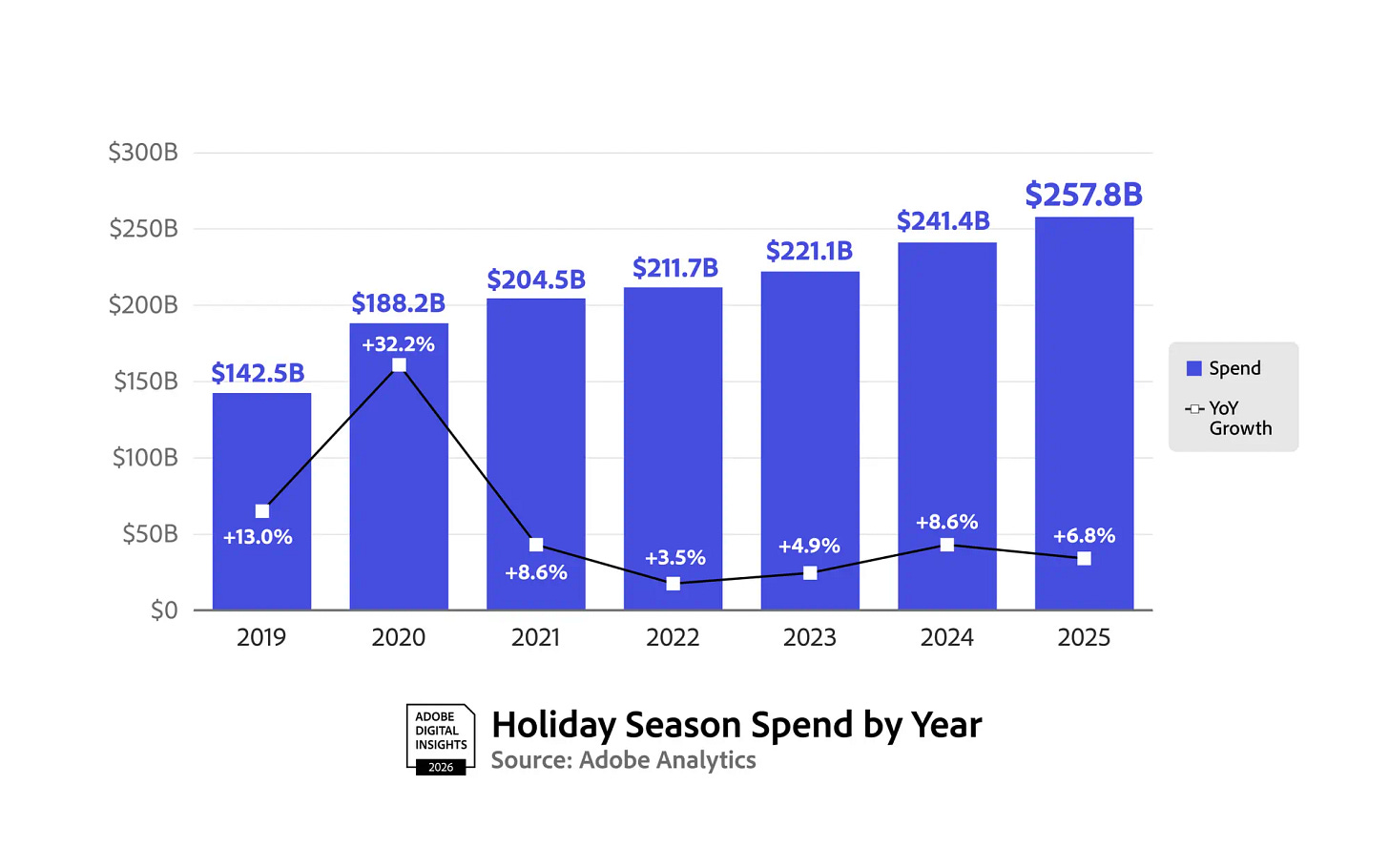
According to the latest Adobe Analytics data, US online spending reached $257.8 billion in the 1 November–31 December 2025 holiday period, up 6.8% year on year. The most striking detail is that the number of days on which consumers spent more than $4 billion rose to 25, a marked increase in "high-volume days" from 18 in 2024. Cyber Week again carried the season, with $44.2 billion in five days and Cyber Monday keeping the top spot at $14.25 billion. Mobile's share rose to 56.4%; purchases are accelerating on mobile while desktop still dominates returns, showing the customer journey split across two screens. BNPL (buy now, pay later) passed $20 billion, becoming a standard payment behaviour, especially on mobile. Another shift came in discovery: traffic from generative AI tools to retail sites jumped 693%.
Extra: As the image below shows, the slowdown in growth I mentioned for November in Turkey also applies to the US despite the records. Growth in 2024–2025 slowed by 1.8 points compared with the previous period (2023–2024). We'll see when the Ministry of Trade publishes its e-commerce reports, but I think the rate will be much higher in Turkey.
E-commerce growth is expected to accelerate in neighbouring Bulgaria, which joined the eurozone on 1 January 2026. Adopting the euro is expected to make the country more accessible, especially for cross-border e-commerce companies. Bulgaria has so far had lower e-commerce penetration than the European average. Online revenue in 2025 is estimated at around €1.4 billion, and the share of regular online shoppers is limited. For example, in the southeastern Yugoiztochen region the rate was 21.7% in 2024, compared with up to 91.5% in Utrecht in the Netherlands.
Extra: With the switch to the euro, Bulgaria is directly integrated into Europe's central payment systems. That means smoother payments, lower operating costs and selling without currency risk. Removing the need for currency conversion and hedging makes Bulgaria more attractive for online sellers in Europe. With full access to eurozone infrastructure, the country could become a strategic hub not only for e-commerce but also for logistics, fulfilment and nearshoring.
Amazon will face a price-gouging lawsuit. According to Reuters, a US federal judge rejected Amazon's request to dismiss a class action alleging that it charged excessive prices during the pandemic, allowing the case to proceed. The court said that product shortages, lockdowns and contact restrictions during COVID-19, and the large shift of shopping online, left consumers "no meaningful alternative", and that allegations that Amazon tolerated unfair prices on food and essentials, both on products it sold itself and through marketplace sellers, were reasonably arguable.
TikTok Shop has reached about $1.1 billion in monthly GMV in the US and has generated more than $70 billion in volume globally since the end of 2022. As of 2025, 71.4 million people in the US shopped through TikTok, and almost half of platform users made at least one purchase.
London-based Swap Commerce, which competes with Shopify, announced a new $100 million round just six months after raising $40 million. Founded in 2022, the company offers brands an AI-powered platform covering everything from setting up an e-commerce store to inventory and returns management, and especially end-to-end management of cross-border sales operations, focusing mainly on luxury fashion brands looking to sell globally.
According to Bloomberg, London-based digital banking giant Revolut is in talks to acquire the licensed digital bank FUPS in order to enter the Turkish market. Sources said the talks have not concluded and may not result in a deal.
Frequently asked questions
When does Turkey's simplified customs exemption end?
The regulation published on 7 January 2026 takes effect 30 days later, on 7 February 2026; all individually ordered products from abroad then become subject to customs duty regardless of value.
How do consumers use AI when shopping, according to ChannelEngine?
58% use AI tools for product research, but only 17% are ready to complete purchases directly through AI tools.
How does Asos's new returns policy work?
From 6 January users can see a returns scorecard: below a 70% return rate returns stay free, above 70% a return fee applies, and above 80% a restocking fee is added.