E-Aramızda 74 / Breaking E-Commerce News
General Agenda
As if the world were perfectly calm, let me share fresh tariff news linked to Greenland, Trump's latest dream. An unexpected move came against the determined US President from the EU, led by France, and the United Kingdom: troops were sent to Greenland (for the curious, the numbers are quite symbolic: France sent 15, Germany 13, Switzerland 3, Norway 2, Finland 2, Britain 1 and the Netherlands 1). According to Trump, these moves towards the Greenland he has "claimed" create a picture that is "risky for global security and the future of the planet", so the US had to take tough, swift measures. As a result, Trump imposed a 10% tariff on all goods shipped to the US from these countries as of 1 February 2026, rising to 25% on 1 June 2026. Trump announced the tariff would remain until a deal is reached for the "complete and total purchase" of Greenland. Unless he changes his mind tomorrow morning, of course.
Extra: After the tariff move, leaders and representatives of the countries concerned issued statement after statement. Let's see where this ends for an EU that is drawing ever closer to China.
OpenAI announced that ChatGPT Go, the low-cost subscription tier it launched in India last month, is now available in every country where ChatGPT is accessible. Priced at $8/month in the US, the new Go plan offers 10 times more messages, file uploads and image generation than the free version and is promoted with the promise of "unlimited chat" with GPT-5.2 Instant. The same announcement confirmed a three-tier global structure: Go ($8), Plus ($20) and Pro ($200), with Plus positioned for higher limits and more advanced models and Pro for top-level access and maximum capacity. And here's the crux for e-commerce sellers: OpenAI said it plans to start testing ads "soon" for Free and Go users in the US.
eBay took a new step to simplify customs, one of the most painful parts of cross-border selling, for sellers in Germany. The platform announced it has launched eBay SpeedPAK in Germany in partnership with Orange Connex. In this model, duties and import charges are collected through the platform at the time of sale, before items clear customs. The SpeedPAK move aims to help German sellers reach global markets more easily at a time when European customs rules are tightening.
Extra: Sellers can choose the service as a shipping option when listing items and buy the relevant labels through eBay. Sellers who register by the end of March get 10% off SpeedPAK labels. According to EcommerceNews, after two years of decline eBay returned to growth in Germany in 2024, increasing revenue by $1 million to $972 million.
Turkey's Ministry of Trade announced that, even before the Simplified Customs System change takes effect on 1 February, sharp price increases on some products have come onto its radar and additional inspections and sanctions have been introduced (the date of the change, which had been discussed as 6–7 February, was given as 1 February in the announcement, while 30 days after the Official Gazette publication falls on 7 February). Without naming names, following complaints to the Ministry about posts that went viral on social media after the China-focused e-import regulation, led by Temu, products sold on marketplaces have been put under scrutiny and information has been requested from marketplaces. The Ministry said that once the inspection results are reviewed by the Unfair Price Evaluation Board, sellers found to have made excessive price increases will face administrative fines of up to 1,806,177 TL per violation.
Platforms periodically send sellers notices about Ministry of Trade sanctions, especially when such inspections intensify.
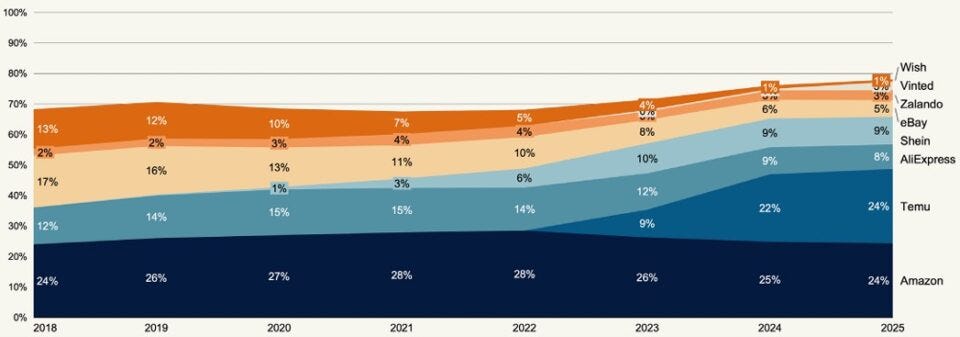
According to the International Post Corporation (IPC) 2025 survey, as the table below shows, the balance in cross-border e-commerce has shifted rapidly. 24% of consumers made their last cross-border purchase on Temu, the same level as Amazon. In other words, in just a few years Temu has taken a seat at the same table as Amazon globally. The most striking part is the speed. Almost non-existent in 2022, Temu went from 1% to 24% in just three years. In the same survey Shein held steady at 9%, AliExpress fell to 8%, eBay stayed at 5%, and the first serious European player was Zalando at 3%. Another key detail is geography: in 26 of 30 European countries, China is the number one destination for cross-border shopping. So the story is not just Temu's growth; Chinese sourcing and price advantage have become the standard in global e-commerce.
One of the expected management moves after Uber Eats acquired Trendyol Go has arrived. Trendyol Go Co-CEO Merve Başcı has been appointed head of Uber Eats' UK operations. In her new role Başcı will manage Uber Eats' delivery operations, restaurant partner relationships, user experience and courier processes in the UK. The aim is for the operational experience gained in Turkey's rapidly scaling delivery model to pay off directly in the UK market. Uber said its Turkey operations will continue under Ege Atikkan, and stressed that its Istanbul Tech Hub retains a strategic role for Uber's global delivery and mobility products.
Amazon has rolled back another returns policy that closely affects sellers. From 8 February 2026, the company is making the Amazon Prepaid Return Label (APRL) (a prepaid return label generated by Amazon) mandatory for all US sellers regardless of item value, eliminating the exemption that applied to high-value items. Amazon defends the step on grounds of a "more consistent returns experience" and "faster refunds", but things look a little different on the seller side. Sellers of expensive and delicate products in particular think losing the ability to contact the buyer directly will increase return rates. Their examples are familiar: a product returned as faulty when the issue could have been solved with a simple usage tip. Sellers of furniture and high-value items say the real risk is damage during returns. According to sellers, no longer being able to explain "how the item should be sent back" shifts the cost directly onto them.
Extra: Some sellers are considering raising prices by up to 10% to protect margins, while others are considering delisting high-risk SKUs entirely. A similar pullback is expected in advertising, with scenarios including cutting budgets for high-priced products they have less control over, or leaving the platform altogether.
THIS ISSUE'S SPONSOR

For Turkey, e-exports hold significant potential given its logistics position and cultural closeness to neighbouring countries. Within a four-hour flight, Turkey has easy access to a retail sector worth a total of $4.2 trillion and a population of 500 million.
Trendyol sees seizing the opportunities of e-exports and supporting Turkey's competitiveness as a key priority. It works to bring 'Made in Türkiye' products to millions of new customers in global markets, and continues as Turkey's e-export champion for the second year in a row.
Having introduced 125,000 SMEs to e-exports so far with its highly streamlined e-export processes, Trendyol will keep unlocking Turkey's cross-border trade potential and contributing to the sustainable growth of Turkish producers.
In Germany, social commerce appears to have moved past the "trial" stage. According to a Bitkom survey, about 29% of German consumers occasionally shop via social media. By far the strongest channel is Instagram: 15% of consumers shop directly on Instagram or via its referrals, followed by Facebook at 14% and YouTube at 11%. TikTok (surprisingly) stays at 8%. German retailers have not ignored the shift: according to another study from mid-2025, 59% of sellers in the country have at least one social media account, 31% actively advertise, and 27% can take orders via social media. So in Germany social commerce is no longer niche but a channel more than a quarter of sellers deal with directly.
Extra: The picture is even clearer among younger people. Among 16–29-year-olds, the share shopping via social media rises to 48%. In this segment Instagram leads with 34%, YouTube is second with 23% and TikTok third with 20%. While German e-commerce is expected to grow by more than 4% a year in the coming years, social commerce is said to be one of the quiet but lasting drivers of that growth.
A major partnership between Apple and Google, rumoured for months, appears to be confirmed. According to a joint statement, Apple's next-generation AI infrastructure will be built on Google's Gemini models and cloud technology under a multi-year agreement. These models will underpin new features under Apple Intelligence, including a more personalised Siri expected in 2026.
According to Şikayetvar data, complaints about virtual POS and digital payment apps rose 247% in the last week alone. The total number of complaints, 1,146 a month ago, has risen 178% to 3,190. The scale of the increase suggests the problem is systemic, not isolated. At the centre of the complaints are mainly user security and cash-flow issues: charges made without information or consent, unauthorised withdrawals, repeated transactions and disputes that go nowhere afterwards. Delays in refunds and customer service make things worse. Users complain that they cannot find anyone to deal with incorrect or unauthorised transactions and cannot get a clear timeline.
Mindsite, which operates in e-commerce and digital shelf analytics, announced it has closed a new $2 million funding round. Participants included Teknoloji Yatırım under TTGV, Sharks & Partners, Finberg, the Technology and Innovation Fund under the Turkey Development Fund, Vestel Ventures, Gelecek Etki Fonu, TT Ventures GSYF, Leap Investment and Ömer Hayrı Erkmen. Notably, most existing investors came back to the table in this round.
AI-powered digital research and analysis platform Manus announced a data integration with web traffic and market data provider Similarweb. Under the new partnership, Similarweb metrics such as web traffic, channel mix and geographic breakdown can now be queried through Manus. Users can access traffic and engagement data for websites going back up to 12 months from within Manus, including monthly traffic, visitor numbers, bounce rate, traffic sources, country breakdown and rankings. Access runs on Manus credits.
TikTok Shop is cutting its handover time to two business days from 26 January. The assessment, previously made at the "awaiting shipment" stage, will now be measured directly by "in transit" status. The transition will run in two phases: four business days between 12 and 25 January, then permanently two days. The most critical change is on the enforcement side, which is hardly unfamiliar to us. Under its new Fulfillment policy, TikTok Shop has introduced an order-based penalty model for the first time. Sellers who ship more than 10% of their orders late will now face the risk of fines.
The cross-border shopping allowance is now on the political agenda as well as the public's. Between the lines of the Ministry of Trade's latest announcement, 1 February stands out as the key date. The political debate over the exemption grows by the day with statements from different sides. On one hand, the Hürriyet Party, which I heard of for the first time (perhaps because I don't follow politics closely), announced it will file for annulment at the Council of State, arguing that the Presidential Decree makes online shopping from abroad effectively impossible (are they wrong?), and it appears to have gained considerable support. On the other hand, the first sign of flexibility came from the ruling side. AK Party spokesperson Ömer Çelik said the main aim of the new customs rules is to prevent unfair competition and protect consumer health and product safety, but that new assessments could be made "in exceptional cases with technological necessity", opening the door to the rules not being absolute.
TikTok has quietly launched a new mini-drama app called PineDrama in the US and Brazil. The idea: every piece of content is a fictional series made of one-minute episodes. So the TikTok feel remains, but instead of dances, trends or vlogs you get a mini-series stitched together. The app is free on iOS and Android and currently ad-free. Content is divided into genres such as thriller, romantic drama and family. Users can browse popular or trending series in the "Discover" tab, resume from their watch history, create favourites lists and engage through comments.
Extra: According to the latest data, the mini-drama market is heading for $26 billion a year by 2030. PineDrama is said to be positioned as a direct rival to mini-drama platforms such as ReelShort and DramaBox.

Wing, the drone delivery company owned by Google parent Alphabet, is expanding its Walmart partnership for the second time. The company announced it will launch drone delivery at 150 more Walmart stores in the US. The model, which started in Dallas-Fort Worth and Atlanta, will spread throughout 2026 and expand gradually through 2027. With this step, the number of Walmart stores where Wing operates will exceed 270, reaching about 10% of the US population. According to Wing, the most active 25% of customers use the service three times a week on average. The most common items are everyday staples: eggs, ground beef, tomatoes, avocados, lemons and packaged snacks.
Shopify is repositioning its infrastructure on the assumption that the next big shift in e-commerce will be "agentic commerce". The company announced that the Universal Commerce Protocol (UCP), an open standard developed with Google, makes it possible to bring commerce directly into AI conversations. With this move, merchants on Shopify will be able to sell through channels such as AI Mode in Google Search, the Gemini app, Microsoft Copilot and ChatGPT without a separate store experience. Notably, Shopify is not limiting the model to merchants using its own stores: with the new Agentic plan, Shopify Catalog is also opening to brands that do not use Shopify.
Frequently asked questions
What tariffs did Trump announce over Greenland?
A 10% tariff from 1 February 2026 on all goods from the countries that sent troops to Greenland, rising to 25% on 1 June 2026.
How much does ChatGPT Go cost?
$8 per month in the US. The global tiers are Go ($8), Plus ($20) and Pro ($200), and OpenAI plans to test ads for Free and Go users in the US.
What changes for Amazon sellers' returns?
From 8 February 2026, the Amazon Prepaid Return Label (APRL) is mandatory for all US sellers regardless of item value.